In the United States, several polling organizations measure public opinion on the death penalty at a national level, with Gallup being a particularly prominent player in this field. The value of Gallup’s data lies not only in the scope of its public opinion research, but also in the continuity of its time series and the consistency of its question wording over many decades. A salient feature of Gallup’s work is its use of two distinct primary formats to assess public attitudes towards capital punishment for individuals convicted of murder.
- The first is a binary question (yes/no type), used since 1936, which asks respondents whether they are “in favor” or “not in favor” of the death penalty, without presenting any alternative sentencing option. Since 1999, this question has been included in every annual Gallup poll.
- The second is a comparative question, first introduced in 1985, which asks respondents to choose between the death penalty and life imprisonment without the possibility of parole (LWOP). This format has been used intermittently, often with gaps of several years, and most recently in 2019.
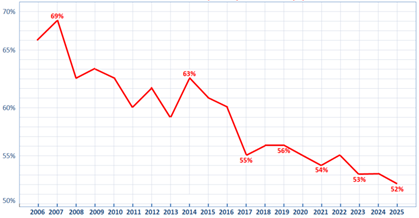
Polls using the binary question, over the past several decades, have consistently reported majority support for the death penalty, although this support has declined substantially from a peak of 81% in 1994 to 52% in 2025 [1]. Read in isolation, these figures suggest that capital punishment continues to enjoy widespread public support.
Answers in favour of the death penalty in the binary question
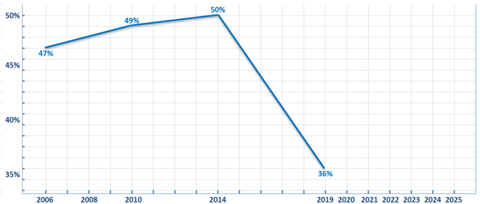
By contrast, responses to the comparative question reveal a very different picture. In 2019, the last year Gallup included this format, only 36% [2] of respondents preferred the death penalty, a figure twenty percentage points lower than the 56% recorded in the binary format in the same year.
Answers in favour of the death penalty in the comparative question
Gallup’s historical data from the ten years in which both question formats were used in the same year, confirm a consistent pattern: support for the death penalty is always much higher when measured by the binary question than by the comparative question, with an average gap of 17 percentage points.
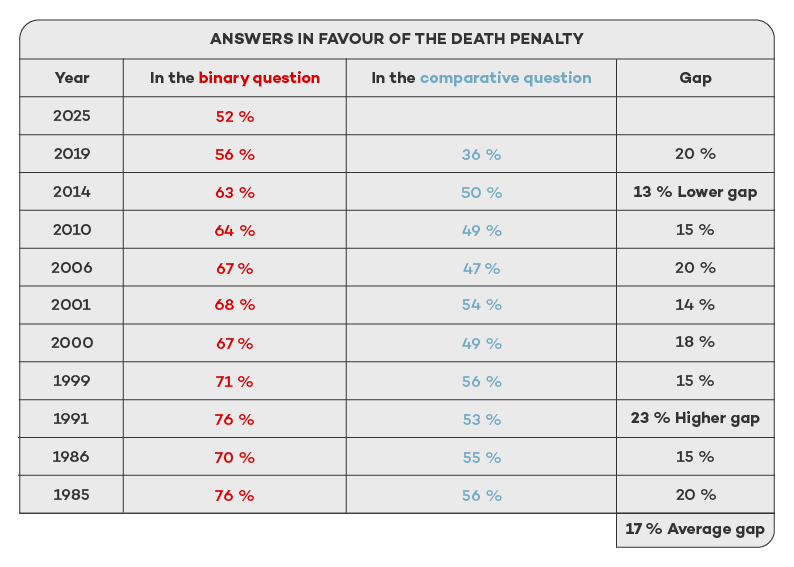
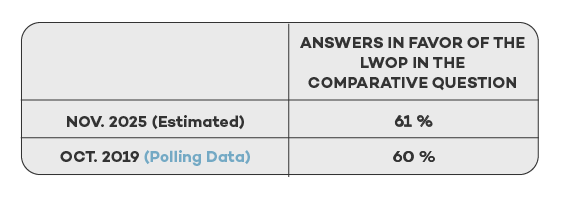
Applying the above average of these established historical differences, it is possible to estimate with a reasonable degree of confidence that, under the comparative format, a poll conducted in November 2025 would have shown support for the death penalty at approximately 35%, a level similar to the one registered in 2019 (36%). Even when applying the minimum gap observed (only once) in the Gallup polls, public support for the death penalty would remain below a majority threshold, reaching at most 41% in 2025. In other words, the apparent majority support for capital punishment suggested by the binary question would certainly continue to be inexistent once a realistic alternative sanction is explicitly presented.
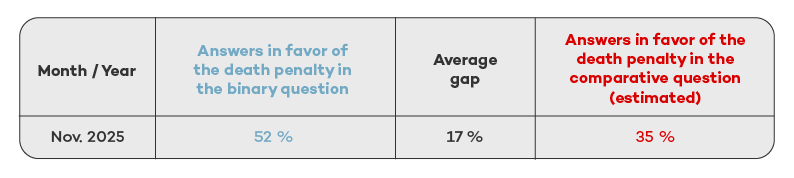
The comparative question is methodologically important because it captures not only support for the death penalty but also support for its most common alternative. In 2019, 60% of respondents preferred life imprisonment without the possibility of parole. Gallup’s historical data further suggest that, under this question format, declines in support for the death penalty tend to be accompanied by increases in support for LWOP. Given the estimated relative stability of death-penalty support from 2019 to 2025 under this format, it is plausible to infer that support for LWOP over the same period did not deviate substantially from the 2019 level, being estimated at 61% in 2025.
A similar dynamic is observable at the state level. A survey conducted in the State of Ohio from 18 to 22 September 2023 produced a similar result regarding public preference for LWOP. When asked whether the governor should sign a bill replacing the death penalty with life imprisonment without parole, 58% of respondents answered yes [3].
These findings highlight a central limitation of the binary question: by suppressing the choice of an alternative sanction, it systematically overstates the degree of public support for capital punishment and raises an important issue: is the apparent majority support for capital punishment shown by the binary question a stable reflection of public preferences, or to a significant extent, an artifact of question design?
Simple, binary questions like the typical “yes/no” format or “in favor/not in favor”, force respondents to choose between options that may not fully capture their nuanced views. While these questions are straightforward, their simplicity limits their ability to provide meaningful insights. As noted in Survey Methods [4], dichotomous questions like “yes/no” often fail to allow for a deeper analysis of public sentiment.
Moreover, when no concrete alternative to the death penalty is offered, respondents may fear that rejecting capital punishment implies support for a lenient or insufficiently punitive sanction. This concern can artificially inflate support for the death penalty.
The US Death Penalty Information Center, referring to the responses to the simple binary question, emphasizes that they might reflect the public’s philosophical or moral stance on the issue, but they do not measure opinion about the death penalty as it is actually practiced which requires such information as the availability of alternative sentences, the risks of mistake and bias, and the costs associated with the practice [5].
As early as 1989 [6], Hans Zeisel and Alec Gallup (co-chairman of the Gallup Poll and son of the organization’s founder), stressed that “Death penalty sentiments are not of uniform strength: about one-third of the pro-death penalty population might give up their position if the alternative were life without parole and if they were convinced that the death penalty is not a deterrent”.
The prevalence of the simple binary question
Despite overstating the support for the death penalty, the simple yes/no format remains the most commonly used format in public opinion surveys on the death penalty. Between 1985 and 2025, Gallup conducted 39 separate polls using the binary question, but only 13 [7] included a question with LWOP as an alternative. Moreover, 2019 marked the last year Gallup reported LWOP comparative results, even as the binary question continues to be featured annually. Gallup’s website also reflects this imbalance: binary results are prominently displayed at the top of the page, while LWOP-comparative results are relegated further down and presented without graphical representation.
Even so, Gallup is one of the few polling organizations that includes the comparative question at all; most other pollsters rely exclusively on the binary format.
Given the significant influence of public opinion on criminal-justice policy, including legislative debates, executive decision-making, and electoral strategy, it is essential that surveys accurately reflect the complexity of public attitudes. Overly simplistic yes/no questions, distorting public sentiment may ultimately contribute to inadequately informed policy decisions.
Why is public support for the death penalty declining?
The evidence presented above shows a marked long-term decline in public support for the death penalty. Most significantly, a majority of Americans no longer view capital punishment as the most appropriate sanction for the most serious crimes. Several interrelated factors contribute to this shift, including:
- Growing awareness of the risk of executing innocent people
- Increased recognition of racial bias in the application of the death penalty
- Growing awareness that the death penalty disproportionately impacts the poor
- The public knowledge of the high cost of death penalty
- Decline in public belief in its deterrent effect
- Bipartisan involvement in condemning capital punishment
- The decline in the use of death penalty in the U.S.
- The influence of global trends toward abolition of the death penalty
The next section of this article elaborates on each of these factors.
Growing awareness of the risk of executing innocent people
Contributing to this trend away from the death penalty is the number of wrongful death sentences, overturned years later, sometimes decades later, during which people falsely accused, suffer on the death row under the menace of being killed.
In the United States, courts have exonerated more than 200 people who were wrongfully sentenced to death over the past 50 years, an average of about four exonerations per year.
“The wrongful convictions of these people are the result of mistakes, misconduct, and the political ambitions of government officials that the American public should no longer tolerate” [8] said Robin Maher, executive director of the Death Penalty Information Center.
Larry Roberts [9] was the 200th prisoner to be exonerated by a US court on 1 July 2024, after languishing for 41 years on death row waiting to be killed by the state for a crime he did not commit.
A 2021 report [10] documented that 69% of death row exonerations are the result of death sentences involving official misconduct by police, prosecutors, or other government officials. Eyewitness misidentification, faulty forensics, false confessions, and inadequate defense are among other legal challenges that lead to wrongful death convictions.
Besides the over 200 exonerated, some sentenced to death have been found innocent too late. After they had already been executed. These cases are less well known because investigations usually stop after the execution. Carlos DeLuna [11] is one the 20 cases listed by DPIC [12]. He was executed in 1989 for the stabbing to death of a Texas convenience store clerk. Evidence uncovered years later showed that another man, Carlos Hernandez, who had even confessed to the murder, had actually committed the crime.
Notwithstanding the well-known enormous amount of judicial errors at all levels, the few US states that still use the death penalty continue to execute people even when there are serious doubts about the guilty. A recent case is Marcellus Williams [13], who was executed in Mississippi in October 2024, despite serious claims of innocence not only by his defense team, but later by the prosecutors themselves. Forensic evidence was destroyed or contaminated by the prosecutor. Available DNA and other forensic evidence from the crime scene did not match Williams. In the end, Williams was sent to death on the basis of two unreliable witnesses who had incentives to testify falsely against him, including leniency in their own criminal cases and a $10,000 reward. Some politicians pretend to be tough on crime by speeding up and increasing the number of executions, despite the certainty that a system riddled with error also kills innocent people. Undoubtedly, populist political goals can trump justice.
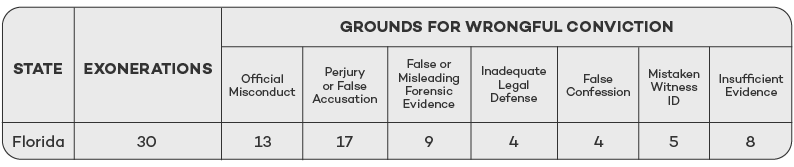
The state of Florida is a perfect example of the populist use of the state’s execution apparatus. In 2025, Florida carried out far more executions than any other state and far more than at any other time in its history. To facilitate this unprecedented level of executions, the state eliminated the requirement for a unanimous jury recommendation in death penalty cases, even though it has the worst record in the United States for wrongful convictions in capital cases: Since 1973, 30 people were exonerated after being wrongfully sentenced to death. Allowing death sentences to be imposed without a unanimous jury recommendation further increases the risk of wrongful convicting innocents to death. According to the Death Penalty Information Center, the 30 known miscarriages of justice in Florida involved a range of contributing factors, including the following:
Increased recognition of racial bias in the application of the death penalty
The death penalty is viewed as racist because it is disproportionately applied to people of color as demonstrated in the Baldus Study [14], which is a comprehensive empirical analysis of 2,484 homicide cases in Georgia. The study revealed that black defendants convicted of killing white victims were more likely to be sentenced to death than any other racial combination of defendant and victim, even when the crimes are similar. These conclusions are confirmed in numerous other studies [15].
Racial discrimination also exists in the jury selection process [16], further distorting the fairness of death penalty cases. Black jurors are frequently excluded from juries in capital cases involving white victims.
The historical context of the death penalty reveals its racialized roots [17]. The system of capital punishment in the U.S. has long been intertwined with racial violence, particularly during periods of slavery and segregation. Historically, Black people were disproportionately targeted for execution, often without due process, and in ways that reflected racist notions of Black inferiority. This legacy continues to shape modern perceptions of the death penalty and contributes to its unequal application. Thus, racial disparities in the death penalty are not just a reflection of present-day biases but also of a history steeped in racial inequality and injustice.
Growing awareness that the death penalty disproportionately impacts the poor
The death penalty disproportionately impacts the poor because of the intersection of limited legal resources, systemic biases, and socio-economic factors. Those who cannot afford adequate legal defense are more likely to be sentenced to death, even in cases where wealthier individuals may have been able to avoid such a fate. Below are indicated some factors that have contributed to increasing recognition of this issue in the US.
Advocacy by Organizations: the Innocence Project, Equal Justice Initiative (EJI), and the Death Penalty Information Center (DPIC), to cite but a few, have highlighted the role of poverty in capital cases. They expose the systemic inequities in the criminal justice system and the ways in which poverty intersects with race and legal defense. Their work has been instrumental in raising public awareness about how poor defendants are more likely to face the death penalty due to inadequate legal representation and lack of resources.
Public education campaigns around the death penalty, often focus on its unfair application. These campaigns highlight the fact that those who cannot afford competent legal counsel are at a higher risk of being sentenced to death. Documentaries, books, and news reports have further brought the issue to light, particularly focusing on the unequal outcomes for poor defendants in capital cases.
Legal and Academic Research: Studies, such as those by the Baldus Study and the American Bar Association [18], have demonstrated that the death penalty disproportionately affects the poor. Their findings have been widely cited in legal and academic circles, and they have influenced public discussions about the fairness of the death penalty.
High-Profile Cases: Media coverage of cases where poor defendants have been sentenced to death without adequate legal counsel has helped bring this issue into the public consciousness. For example, cases like Troy Davis [19] and Leonard Peltier have garnered attention because of concerns about the fairness of their trials and the lack of resources for their defense. These cases have drawn attention to the disparities faced by poor people when charged with capital offenses.
Troy Davis case: The case was extensively covered by national and international media, highlighting how Davis, a poor defendant, lacked the means to mount a robust defense. Journalists, celebrities, and advocacy groups rallied to his cause, drawing attention to the possible flaws in the trial and the impact of poverty on his case.
The public knowledge of the high cost of death penalty
A further persuasive evidence that influences public opinion is the cost disadvantage of the death penalty in the USA compared to life imprisonment. The legal process is much longer “Capital cases require more lawyers, more witnesses, more experts, a longer jury selection process, more pre-trial motions, an entirely separate trial for sentencing, and countless other expenses,” summarizes Equal Justice USA [20]. Then there are the costs, in some cases, of lawsuits against states for ‘botched’ executions. According to a 2016 study by Susquehanna University, each death row inmate costs about $1.12 million more than an inmate in the general population [21]. A similar conclusion has been reached by other studies, such as a 2013 study published by the University of Denver Criminal Law Review, which examined aggravated murder prosecutions between 2005 and 2010 in Colorado [22].
The economic inefficiency of capital punishment, especially in an era of fiscal austerity is increasingly recognized as a significant factor in the broader debate over the future of the death penalty in the US.
The Death Penalty Information Center, theInnocence Project, and the National Coalition to Abolish the Death Penalty have consistently highlighted the economic burden of the death penalty. Through reports, media campaigns, and public advocacy, these groups raise awareness of how these financial costs divert resources away from more effective public safety measures, such as crime prevention, education, and rehabilitation programs.
Decline in public belief in its deterrence effect
According to Gallup polls, the percentage of Americans who believe in the deterrent effect of the death penalty on future crime is very low, falling from 13% in 1991 to 6% in 2015 (the last time the question was asked). Back in 2012, the prestigious National Research Council for the National Academies concluded that “research to date on the effect of capital punishment on homicide is not informative about whether capital punishment decreases, increases, or has no effect on homicide rates” [23].
Bipartisan involvement in condemning capital punishment
The decline in public support and in the use of the death penalty in the US is also the result of the efforts of a vibrant civil society with a bi partisan political support of many Democrats and an increasing number of Republicans. In 2013, a network called “Conservatives Concerned About the Death Penalty” [24] was set up to raise concerns about capital punishment in media and other fora. The network released a major report in October 2017, titled “The Right Way” [25], which highlighted that the death penalty is “plagued by wrongful convictions, high costs, and delays” and that “the death penalty has proven to be ineffective and inconsistent with a number of core conservative principles” and “runs counter to conservative commitments to limited government, fiscal responsibility, and a culture of life.” According to the report, dozens of Republican lawmakers accounted for about a third of all sponsors of death penalty repeal bills in state legislatures in 2016 and 2017. The report concludes that “The death penalty is dying in the United States, and Republicans are contributing to its demise. A surge of Republican lawmakers have sponsored death penalty repeal bills since 2013, symbolizing a shift in conservative attitudes that extends far beyond the statehouse. Lawmaker activity is a reflection of this growing trend. The death penalty’s egregious flaws – the risk of executing an innocent person, arbitrariness and bias, high costs, a lack of deterrence, and the impact on victims’ families – make it impossible to square this policy with conservative values. Conservatives from the grassroots to statehouses are taking note and leading the way towards better policies that don’t include executions”.
The decline in the use of death penalty in the U.S.
This shift in public opinion in the US is in line with the history of a progressive decline in the use of this punishment in the country, particularly over the last 20 years. The US has been a pioneer in abolishing the death penalty. The first three states to abolish the death penalty did so in the 19th century. In the following century, abolition accelerated from 3 to 9 states, and in the first quarter of the 21st century, 11 new states have abolished, an average of one state every two and a half years, a remarkable acceleration.
| XIX Century |
| 3 States abolished |
| Michigan (1846) |
| Wisconsin (1853) |
| Maine (1887) |
| XX Century |
| 9 States abolished |
| Minnesota (1911) |
| Alaska (1957) |
| Hawaii (1957) |
| Vermont (1964) |
| West Virginia (1965) |
| Iowa (1965) |
| North Dakota (1973) |
| Massachusetts (1984) |
| Rhode Island (1984) |
| XXI Century |
| 11 States abolished |
| New Jersey (2007) |
| New York (2007) |
| New Mexico (2009) |
| Illinois (2011) |
| Connecticut (2012) |
| Maryland (2013) |
| Delaware (2016) |
| Washington (2018) |
| New Hampshire (2019) |
| Colorado (2020) |
| Virginia (2021) |
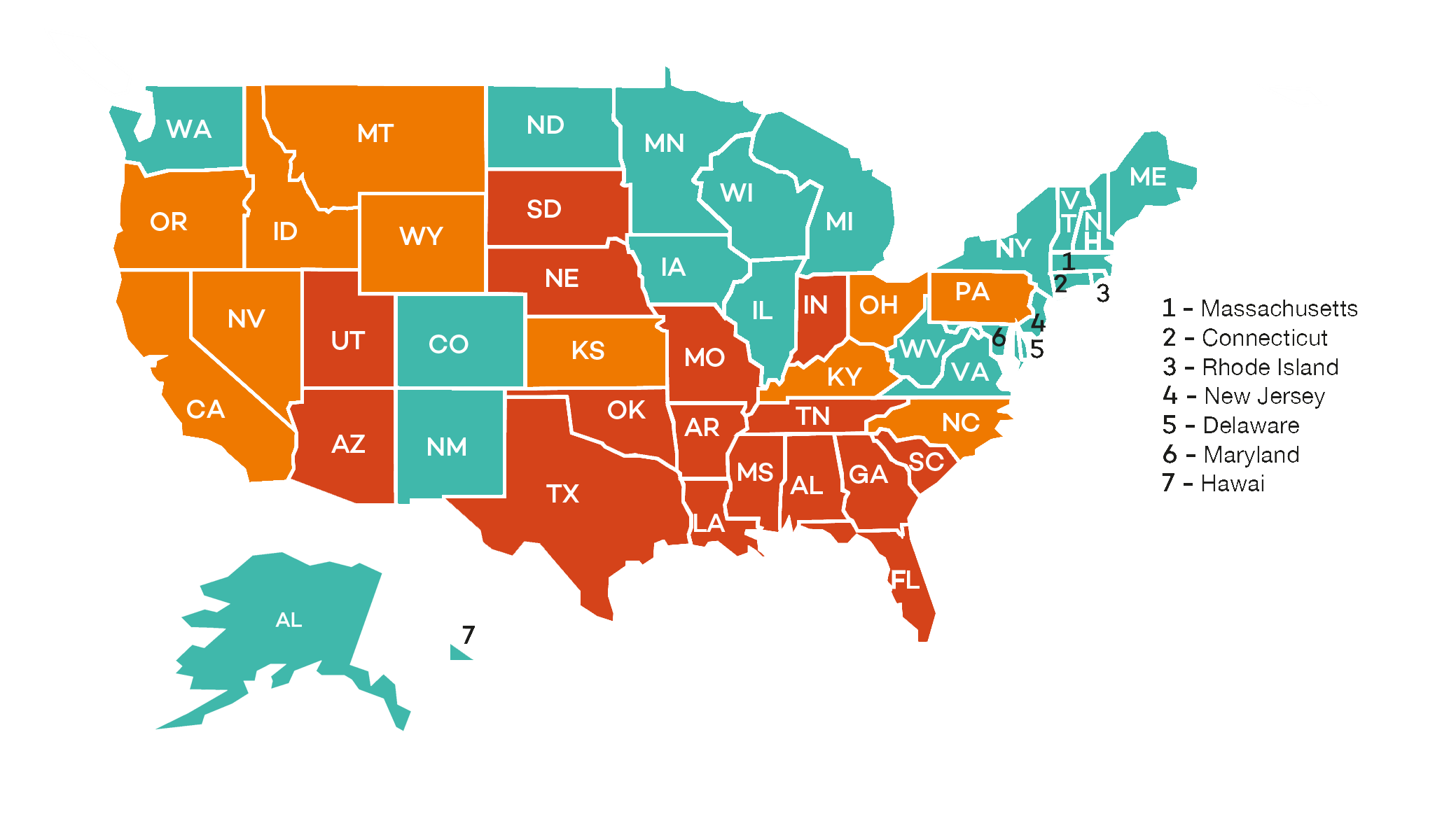
In addition to the 23 States that have already abolished the death penalty by having it removed from their Penal Code, 11 other States declared a moratorium on executions or are in a de facto moratorium (stopped executing for 10 years or more). Those States are [26]:
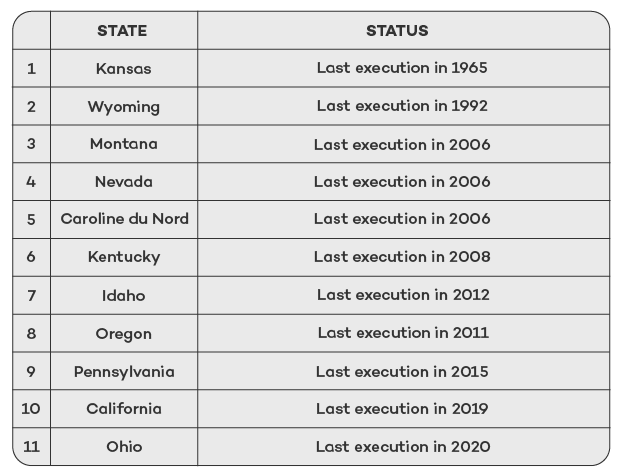
In total, 34 states, or 68% of the 50 states composing the US, do not use the death penalty, either because they have abolished it by law or because they have stopped carrying out executions.
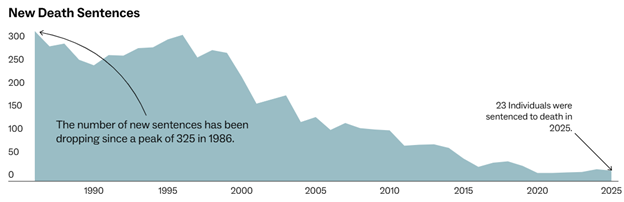
The decline in the use of the death penalty is also evident in annual sentencing figures. In 2025, courts issued 23 new death sentences, the fifth consecutive year in which fewer than 30 individuals were condemned to death.
The lack of public enthusiasm for the death penalty in the US is also reflected in another Gallup indicator related to public opinion: the percentage of Americans who believe it is applied fairly. In October 2023 [27], only 47 per cent of Americans considered that it was applied fairly, a drop of two percentage points since the previous similar poll in 2018.
The influence of the global trend towards the abolition of the death penalty
Another factor weighing on public opinion against the death penalty is the growing global trend towards abolition. Most countries in the world have already abolished the death penalty from their legal framework (61%). This percentage rises to 84% if we include countries that have not yet abolished the death penalty in law, but have not carried out executions in the last 10 years or more. In other words, if we include countries that have abolished the death penalty in practice, but not yet in law. For example, on the entire American continent (North, Central and South), only a few states in the US still execute people.
Summing up
Public opinion on the death penalty in the U.S. has shifted significantly in recent years, with growing support for life imprisonment over capital punishment. Apparent majority support for the death penalty in the United States is largely a product of survey design. While binary yes/no questions continue to suggest broad approval, comparative formats that include life imprisonment without parole show that support for capital punishment falls well below a majority threshold. The persistent gap between these measures indicates that public preferences are more accurately captured when realistic alternatives are presented. More nuanced and comparative survey instruments are therefore essential for accurately assessing public views and informing policy debates.
Several factors contribute to this trend, including increased awareness of wrongful convictions. Racial bias is another significant issue, as studies show Black defendants are more likely to be sentenced to death, especially in cases involving white victims. Additionally, the death penalty disproportionately affects the poor, who often lack adequate legal defense.
The high costs of capital punishment, which are much greater than life imprisonment, have also led to growing public concern about its financial inefficiency. Furthermore, the belief in the death penalty’s deterrent effect has waned, with only a small percentage of Americans believing it prevents crime. The bipartisan push for abolition, alongside global trends toward the end of the death penalty, reflects a broader societal shift. These factors, combined with a decline in executions, suggest that public support for the death penalty is steadily decreasing in the U.S.
Adriano Martins, ECPM’s Boardmember
Sources
[1] First table on https://news.gallup.com/poll/1606/death-penalty.aspx
[2] Fifth table on https://news.gallup.com/poll/1606/death-penalty.aspx
[3] https://www.acluohio.org/app/uploads/2024/01/thepushfordeathpenaltyrepealinohio_2024-0117.pdf?utm
[4] Why to Avoid Dichotomous Questions – SurveyMethods
[5] Public Opinion | Death Penalty Information Center
[6] Death Penalty Sentiment in the United States on JSTOR
[7] Of the 13 polls that included LWOP, two were conducted in years when the binary question was not asked.
[8] Exoneration Milestone a ‘Sobering Reminder’ of Problems With Death Penalty – The Tablet
[9] Larry Roberts – National Registry of Exonerations (umich.edu)
[10] DPIC Special Report: The Innocence Epidemic | Death Penalty Information Center
[11] https://www.theguardian.com/world/2012/may/15/carlos-texas-innocent-man-death
[12] https://deathpenaltyinfo.org/policy-issues/innocence/executed-but-possibly-innocent
[13] https://innocenceproject.org/cases/marcellus-williams/
[14] David Baldus and the Legacy of McCleskey v. Kemp
[15] Race | Death Penalty Information Center
[16] Race and the Jury
[17] Peculiar Institution: America’s Death Penalty in an Age of Abolition on JSTOR
[18] Criminal Justice Debt Problems
[19] Troy Davis and the Quest for Justice – Harvard Law School | Harvard Law School
[20] Fact check: Is the death penalty more expensive than life in prison? – Ballotpedia
[21] The Death Penalty vs. Life Incarceration: A Financial Analysis (researchgate.net)
[22] https://digitalcommons.du.edu/cgi/viewcontent.cgi?article=1020&context=crimlawrev
[23] Deterrence and the Death Penalty | The National Academies Press
[24] Conservatives Concerned About the Death Penalty
[25] The-Right-Way-Online.pdf (conservativesconcerned.org)
[26] Source: https://deathpenaltyinfo.org/state-and-federal-info/state-by-state
[27] https://news.gallup.com/poll/513806/new-low-say-death-penalty-fairly-applied.aspx