© Photo credits : KontraS
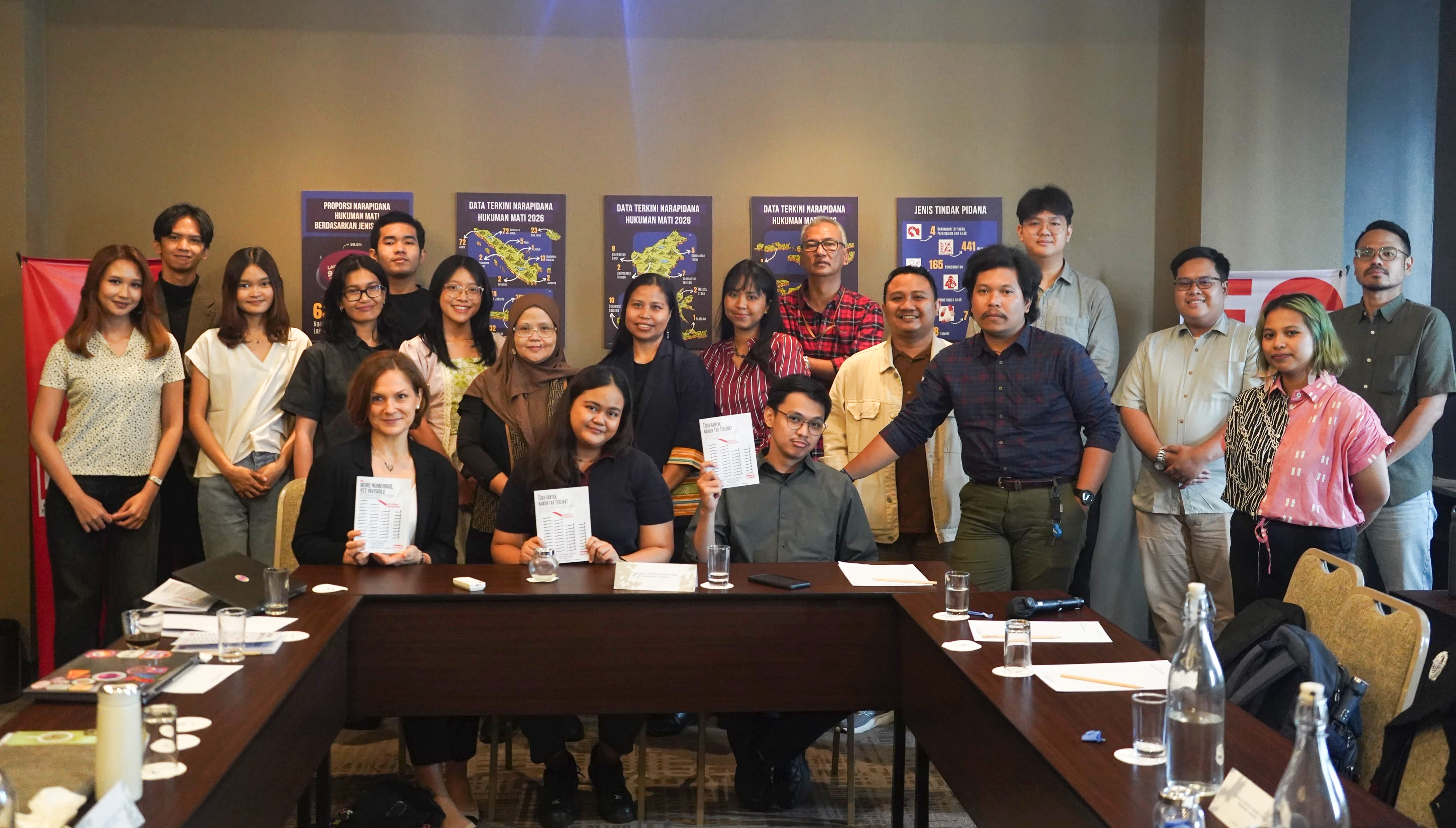
Official publication of the fact-finding mission report, October 13 2026, Jakarta (Indonésia)
In 2019, “Dehumanized“, a fact-finding mission report published by ECPM and KontraS, demonstrated that the suspension of executions did not signal a move towards abolition.
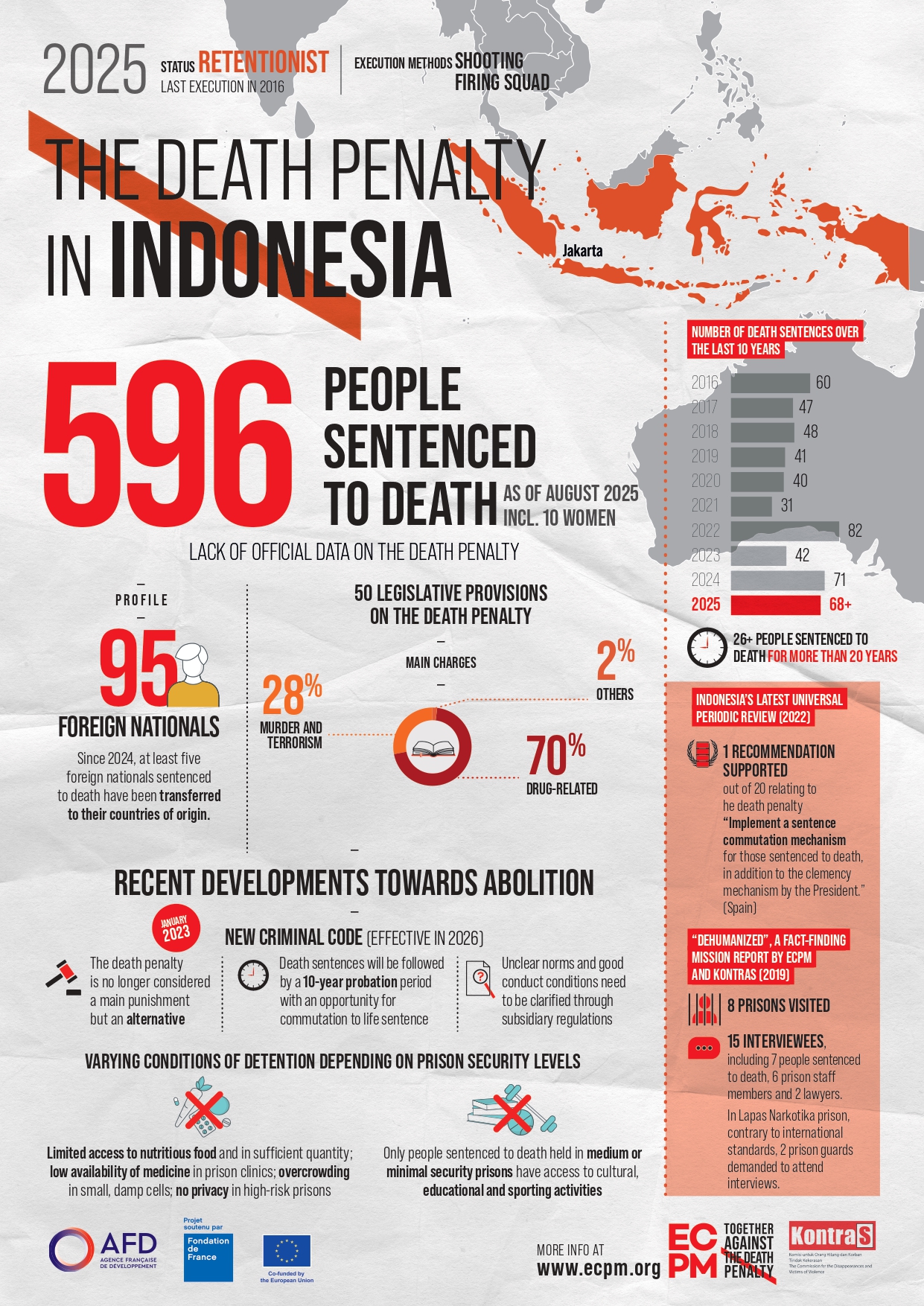
Instead, it left in men and women facing decades on death raw in harsh conditions of detention. Seven years later, this new report documents changes in Indonesia’s approach to capital punishment. The entry into force of the new Criminal Code and the amendments introduced in 2026 mark a shift towards a more conditional and less irreversible approach to the death penalty, although capital punishment remains in place and sentences are being handed down at an alarming rate. By April 2026, 639 people were under death sentence of death, more than twice the number recorded in 2019.
Between October 2024 and December 2025, a team of investigators conducted this fact-finding mission. They visited six prisons and met eight people sentenced to death, around a dozen prison staff members and representatives of civil society.
The growing number of people sentenced to death in Indonesia
Although Indonesian law provides for the death penalty for a wide range of offences, its application has historically been selective. Since independence, executions have been carried out in relation to only four categories of crimes: subversion, aggravated murder, terrorism and drug-related offences. Subversion, which once played a central role in capital sentencing, has since disappeared as a criminal offence.
Drug-related offences have become the leading grounds for death sentences in Indonesia.
The death penalty remains firmly embedded in Indonesia’s legal system
Despite the absence of executions since 2016, Indonesian courts continue to impose death sentences, and the number of people on death row has risen significantly. In 2025 alone, Indonesian courts imposed at least 68 new death sentences, the vast majority for drug-related offences, placing Indonesia among the countries most actively resorting to capital punishment worldwide.
Foreign nationals are particularly affected. Official data from 2025 indicate that 95 foreign nationals from around a dozen countries were under sentence of death, 94 of them for drug-related offences. By April 2026, the number of foreign nationals under death sentence had risen to 97.
Worsening conditions of detention
Across the facilities visited, people sentenced to death reported living in conditions similar to those of other prisoners, with no specific arrangements reflecting their death-row status.
Access to mental healthcare remains a major structural gap. As documented in the 2019 fact-finding mission, access to psychological and psychiatric care is extremely limited. This lack of support leaves many people sentenced to death particularly vulnerable to psychological distress. For Rizal, the most difficult aspect is “waiting in uncertainty”. The lack of appropriate care is compounded by the absence of specific training for prison staff on the needs of people sentenced to death. Indonesia’s detention model is focused on security considerations rather than on the specific needs of the individuals incarcerated.
Prolonged uncertainty also takes a toll on social and family relationships. Several interviewees explained that family visits had become increasingly rare, primarily because of geographical distance and travel costs.
About KontraS
KontraS (Commission for the Disappearances and Victims of Violence) is an Indonesian NGO set up in 1998 to raise awareness of victims of judicial abuse in Indonesia. It works to improve respect for and protection of rights in Indonesia through advocacy, investigations and campaigns. KontraS investigates issues such as enforced disappearances, torture, impunity and violations of civil, political, economic, social and cultural rights. The abolition of the death penalty is one of its key areas of advocacy. In partnership with ECPM, it conducted and published a fact-finding mission to Indonesia’s death rows in 2020. The work of KontraS and ECPM since the beginning of their collaboration has been guided by the reform of the penal code and in particular the chapter on the death penalty.
To learn more