
A look back at the facts
Serge Atlaoui arrived in Indonesia in September 2005 and was hired as a machine welder in an acrylic factory in Jakarta. Along with some thirty other people, including a Dutchman and five Chinese, he was arrested in November 2005 following a police raid on what was, in fact, a clandestine laboratory. Serge Atlaoui had never been informed of the illicit use to be made of the machine he had been asked to work on.
Sentenced in 2006 to life imprisonment for drug trafficking at first instance and then on appeal, the case took a radical turn when, in May 2007, following an appeal in cassation initiated by the prosecution, Serge Atlaoui was sentenced to death. The same fate befell the Dutch national. Both were incarcerated on the island of Nusakambangan, south of Java. His Dutch colleague died in custody.
In January 2015, newly elected Indonesian President Joko Widodo rejects Serge Atlaoui’s request for a presidential pardon. The Attorney General’s Office confirmed that day that it had drawn up a list of eleven death row inmates, without specifying who was concerned.
On April 21, the Supreme Court refuses to review Serge Atlaoui’s trial, ruling that there was no new evidence, and two days later, “orders are given by the Indonesian authorities to prepare several executions including that of Serge Atlaoui” within the next few hours.
On Wednesday April 29, 2015, eight death row inmates are executed for drug trafficking. Two Australians (Andrew Chan and Myuran Sukumaran), three Nigerians (Sylvester Nwolise, Okwudili Oyatanze, Raheem Salami) and one Ghanaian (Martin Anderson), one Brazilian (Rodrigo Gularte) and one Indonesian (Zainal Abidin) were shot shortly after midnight.
The names of Serge Atlaoui and Mary Jane Veloso, originally from the Philippines, were withdrawn from the execution list at the last minute. Officially, Serge Atlaoui obtained this stay of execution thanks to a final administrative appeal lodged on April 25 by his lawyer to contest the rejection of his presidential pardon. This appeal was rejected by the Jakarta Administrative Court.
After being relocated to several different prisons, Serge Atlaoui was incarcerated at Salemba Prison in Jakarta.
On December 19, 2024, the French government officially requested Serge Atlaoui’s transfer to France.
Mobilizations and ECPM campaign
On January 18, 2015, Indonesia lifted its moratorium on executions and executed six people sentenced to death, including five foreigners convicted of drug trafficking. In February 2015, ECPM initiated an international mobilization campaign to save Serge Atlaoui and those sentenced to death in Indonesia. After a double citizens’ rally, organized in Paris and Metz on March 24, ECPM launched an appeal for donations to cover the costs associated with the legal proceedings.
On April 25, 2015, a citizens’ rally was held at Beaubourg, joined by the Franco-Indonesian singer Anggun, who is very popular in Indonesia, and who had written to President Joko Widodo imploring him to pardon Serge Atlaoui.
On the eve of the scheduled execution date, FC Metz footballers supported the campaign and wore a “Sauvons Serge Atlaoui Ensemble” t-shirt before the start of their match against Paris Saint-Germain.
On the media front, major national and regional media responded to the event, reporting on the latest legal developments and highlighting the issues surrounding the death penalty in Asia and the rest of the world.
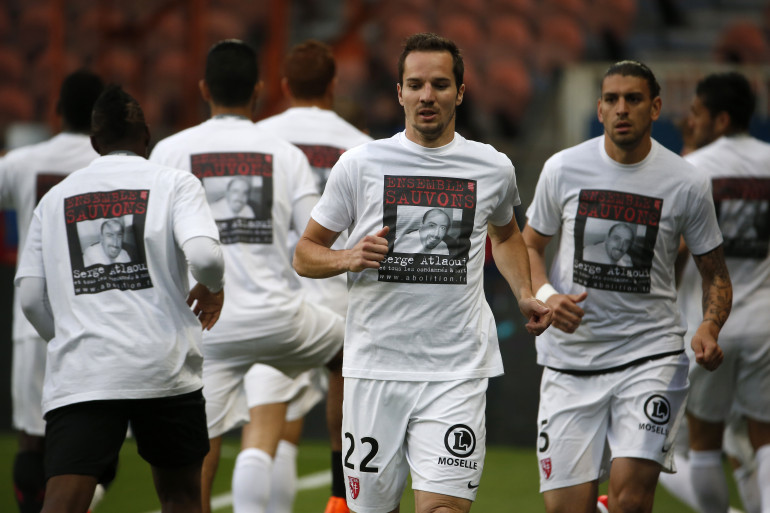
Les joueurs du FC Metz ont arboré un t-shirt de soutien à Serge Atlaoui face au PSG (rtl.fr)
Political mobilisation
Since its abolition in 1981, France has opposed the death penalty in all places and all circumstances. As a matter of principle, it works for the commutation of the sentences of its nationals condemned to death, through diplomatic channels.
The case of Serge Atlaoui was raised on several occasions by the French authorities with the Indonesian authorities as early as January 2015, including at the highest level.
From April onwards, France began to express publicly, through the voice of Corinne Breuzé, French ambassador in Jakarta, that there would be “consequences” for bilateral relations with Indonesia if Serge Atlaoui were executed as planned.
On April 22, President François Hollande appealed to the Indonesian authorities not to execute Serge Atlaoui. Prime Minister Manuel Valls had already expressed his support for the Lorrain native on Twitter: “Defending Serge Atlaoui is a reminder of France’s firm opposition to the death penalty”. Laurent Fabius, for his part, referred to “serious dysfunctions in the Indonesian justice system”, in the face of which Serge Atlaoui “has not benefited from the full exercise of his rights”.
A new hope came in November 2024, when France officially requested his repatriation, responding to statements by Indonesian authorities on the possible return of foreign prisoners to their country of origin. This transfer took place in February 2025 and brought an end to nearly 20 years of suffering for Serge Atlaoui.
For more information
France ‘doing everything to keep Serge Atlaoui alive’ on death row in Indonesia – Learn more
Indonesia rejects French death row convict Serge Atlaoui clemency – Learn more